Robot dogs now cover a wide range of work, from site inspection to research and remote operation. The hard part is deciding what “better” means when one machine may carry sensors, another may climb stairs, and a third may work mainly through a human operator.
- A four-legged robot needs stable footing before speed matters.
- Battery size affects walking time, payload, and sensor use.
- A demo does not prove the robot can work a full shift.
Four legs solve one problem
Four legs keep the robot’s body above uneven ground. Each leg has joints driven by motors, and software changes the foot position as the robot moves.
That lets the robot handle steps, loose ground, and small gaps that can stop a wheeled robot.
The legs also create new limits. Every motor needs power, and every extra movement uses some of the battery. A robot that raises its feet high, carries a heavy sensor, or corrects its balance often will not walk as far as a robot moving on a flat floor.
That trade matters to the person buying one for a plant or construction site. Reaching the inspection point is not enough if the robot needs frequent charging and leaves the task unfinished. Walking ability is useful only when the full route fits inside the machine’s working time.
Sensors make the difference
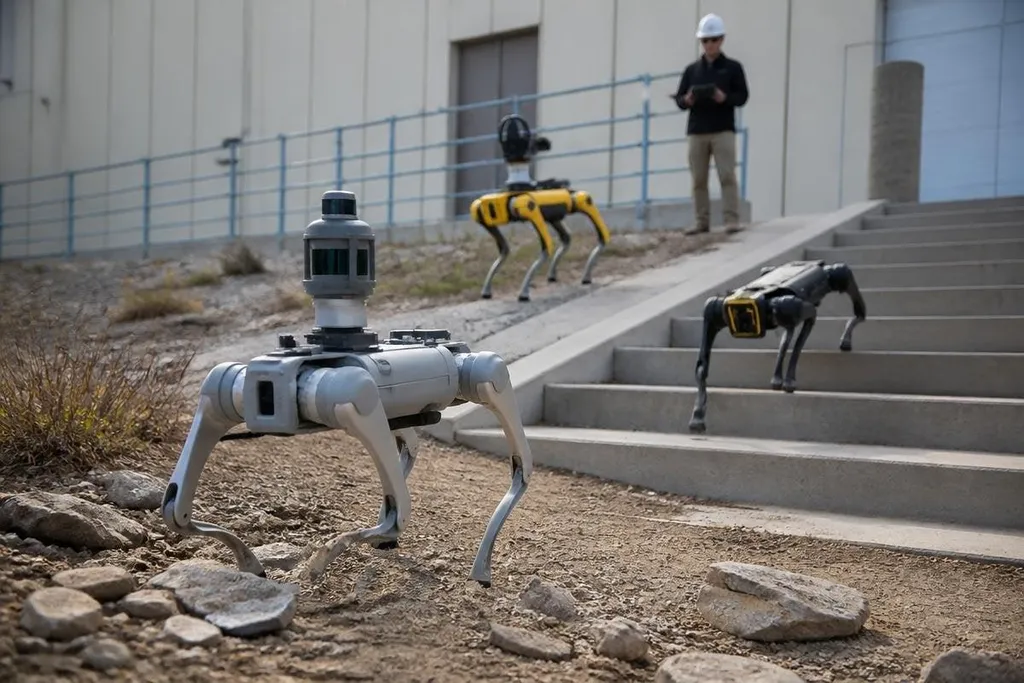
The sensor package may include cameras, LiDAR, microphones, thermal sensors, or other equipment. Cameras can record visual faults. LiDAR measures distance by sending out laser pulses, which helps the robot build a map of nearby walls and objects.
The sensor package changes the job. A thermal camera can help find heat in electrical equipment, but it adds weight and needs software that can read the image. A microphone may help locate a sound, but machinery noise can make that task harder.
This is why product comparisons need more than a walking video. Check the sensor model, its weight, its mounting point, and the software that turns its data into a useful inspection. A robot with fewer sensors may suit a research lab better than a heavier robot built for field checks.
As robot dogs move from demos toward paid inspection work, field robotics reports from Robot24.com can tie each claim to the company, model, test site, and date.
Autonomy is a separate test
Walking without a person holding a controller does not mean the robot can handle the main task alone. Autonomy means the robot can sense its surroundings, choose an action, and recover when the scene changes. That could mean stopping for a person, finding a route around a box, or returning to a charging point.
Remote operation changes the buying decision. A trained operator can guide the robot through a difficult area, but the cost then includes staff time, a control link, and a safe place for the operator to work. A fully autonomous inspection may need more sensors and longer setup work.
The useful question is not whether the robot is autonomous. Ask which parts of the job run without help, what causes a stop, and how the robot reports a failure. Those details decide if one person can manage one robot or several.
What a fair comparison should show
The global race to build better robot dogs will produce many claims about speed, balance, reach, and intelligence. A fair test puts the same task in front of each machine and records the result, including failed runs and recovery time.
I'd skip any comparison that shows only the smoothest video. A short clip can prove that a robot completed one movement. It cannot prove battery life, safe operation near people, weather resistance, or the cost of keeping the machine running.
Use this checklist before you compare models:
- Name the task: inspection, mapping, patrol, research, or remote handling.
- Measure the route: include stairs, doors, slopes, loose ground, and return travel.
- Check the payload: count the robot, battery, sensor mount, and added equipment.
- Record operator time: note how often a person must guide or reset the robot.
- Price the full setup: include software, control hardware, training, repairs, and charging.
- Ask for failure data: request results from repeated runs, not one successful demo.
The next useful robot dog will be the one that publishes this work data beside its walking videos. Until makers show how a machine performs on a named task, under stated conditions, “better” remains a label waiting for proof.